From Persuasion to Memory: The Evolution of the Creative Brief
From what brands say to what the mind remembers


Key takeaways:
Creative briefs have evolved from persuasion tools into memory systems — yet most industry practice still over-indexes on message-first thinking rather than how memory actually works.
Memory-First thinking shifts the goal of advertising from changing behaviour to refreshing and strengthening existing brand memories within real buying situations (CEPs).
Effective communication is less about crafting the “right message” and more about reinforcing mental associations between context, brand, and distinctive assets in the moment of need.
The mind does not operate as a passive storage system, but as a predictive mechanism that continuously blends memory, knowledge, and sensory input — meaning briefs should align with how perception is actually formed.
The real tension today is not “creative brief vs springboard”, but whether briefing systems help teams think in memory structures and practical execution, or remain overloaded strategic documents disconnected from real creative work.

History
The 1st creative brief was introduced in 1964—and, unsurprisingly, it was created by JWT, with Stephen King playing a key role.
The Creative Brief was built on 3 core pillars:
⭕ To focus on responses, not messages: The brief shifted attention from what brands say to what people actually take away from an ad.
⭕ To clarify brand personality: It helped define the brand’s emotional character, giving creatives a clear sense of what makes the brand distinctive and meaningful.
⭕ To define the job of the ad: Each advertisement needed a clear role—whether to prompt action, change perceptions, inform, or reinforce existing beliefs.
And yet, despite this foundation, the 1st creative brief—and the vast ocean of brief templates that followed across agencies worldwide over nearly 60 years—ended up centering almost exclusively on the USP, proposition, or key message → the argument meant to persuade the consumer to change their behavior.
The Persuasion school of thought focuses on convincing consumers through a strong argument, rooted in Message-First (proposition) thinking, with the goal of changing attitudes or behavior. A common assumption in modern advertising is that one big insight or a uniquely entertaining story will make a campaign effective.
As I’ve mentioned many times before, Paul Feldwick’s The Anatomy of Humbug (2015)—a historical analysis of advertising—describes the “Proposition” as nothing more than “the most commonly held belief in the industry.” (p.68)
The problem is not the concept of persuasion. The problem is the industry’s inherited image of how persuasion happens in advertising.
Too often, persuasion is imagined as a hammer hitting a rock: a strong enough message, delivered with enough creative force, will change the consumer’s mind. This is the classic message-first model. Say the right thing, dramatize it powerfully enough, and behavior will shift.
But brand advertising rarely works through a single decisive blow. There is no predictably effective hammer.
No proposition, insight, story, or execution can reliably reshape consumer attitudes on command.
Advertising is more like water on rock. It works through repeated contact over time: refreshing memories, strengthening associations, making the brand feel more familiar, more available, and more relevant when people are ready to buy.
So perhaps persuasion is not something we should reject. We should simply slow it down. In brand advertising, persuasion is usually not an immediate change of mind. It is memory refreshment compounding over time.
Which takes us to a memory-first approach....
🧠 Memory-First Creative Brief
The Memory-First (or Salience = Mental and Physical Availability) approach argues that advertising should primarily refresh existing brand memories, and only occasionally build new ones through gentle nudges and repeated exposure. Its core task is to understand the category entry points (CEPs) — the buying situations in which the brand is chosen — and to strengthen the mental links between those situations and the brand.
In this view, advertising does not primarily aim to change behaviour. Instead, it works through memory: 🧠 making the brand easier to notice, think about, and buy in relevant moments.
Communication therefore often reflects a core buying situation by co-representing the brand and its distinctive brand assets (DBAs), rather than targeting narrowly defined segments or crafting message-driven persuasion strategies.
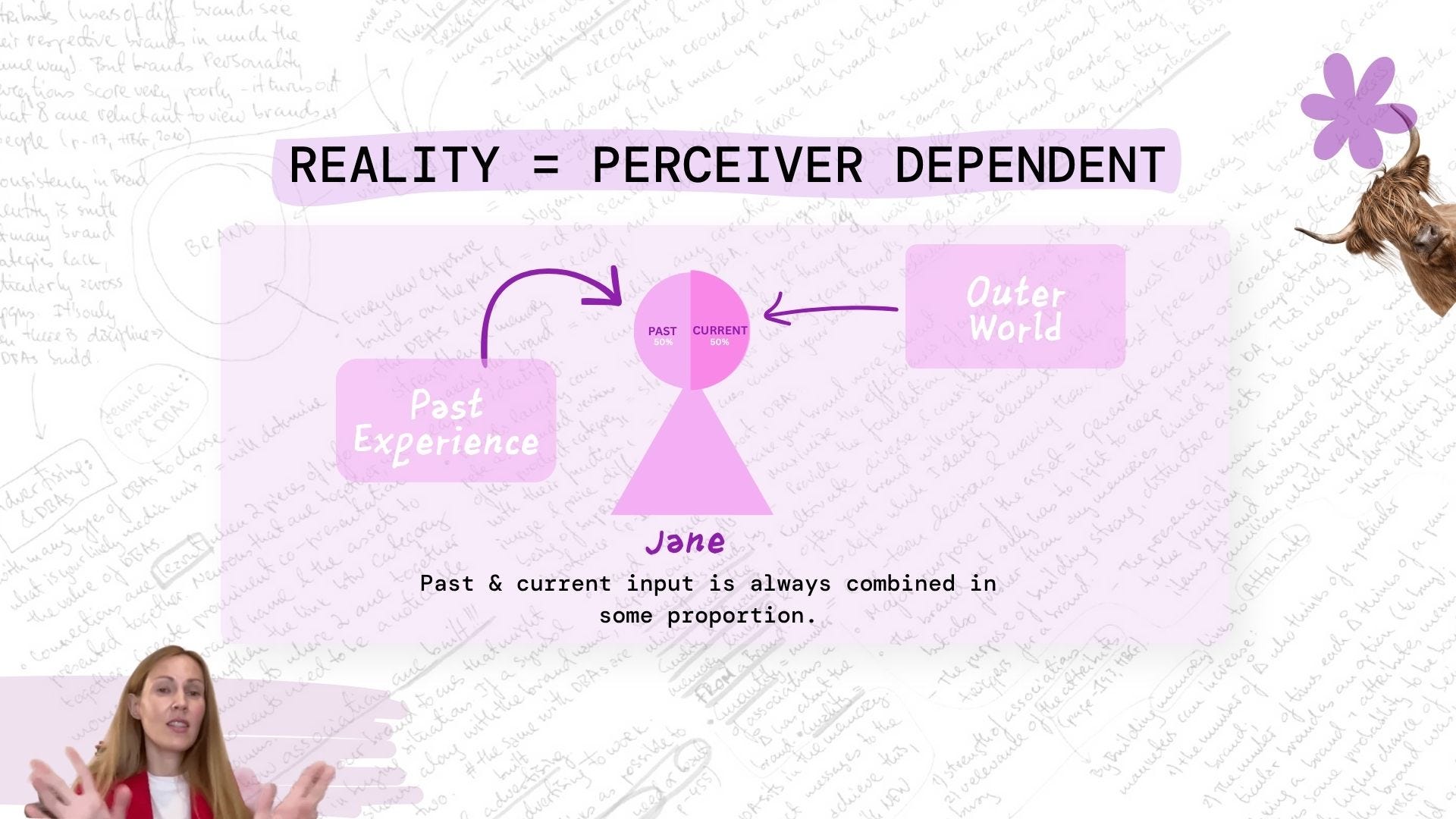
At the centre of brandLingual’s the Memory-First brief is a different assumption about how the mind works. Instead of asking “what message will change consumer behaviour?”, we start from the idea that the human mind is constantly predicting the next moment based on 3 interacting inputs:
past experiences stored in memory
knowledge that has been acquired but not always applied
incoming sensory signals from both the external environment and the body itself
..and the reality is very perceiver dependent.
Can we combine the CEP approach of the Ehrenberg-Bass Institute with Lisa Feldman Barrett’s “Concept” approach?
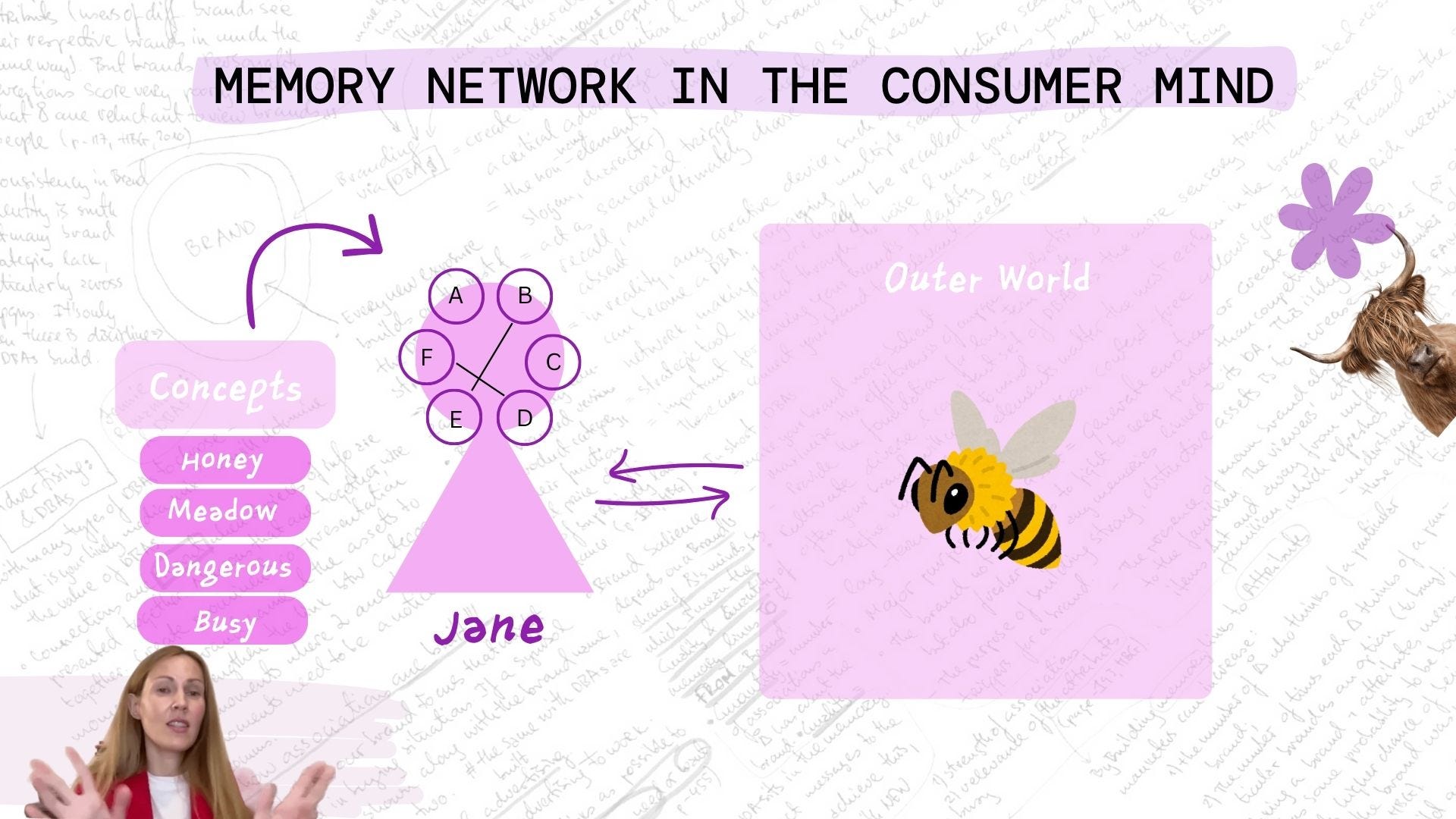
For example, if Jane sees a bee, she associates the bee with the immediate incoming signal — “this bee” — but she also blends it with past experiences and knowledge about bees in general, as well as other related concepts such as “meadow,” “honey,” “busy,” etc.
We can translate this into the CEP framework as well: the CEP network in each individual’s mind operates through associations with direct brand and/or product experiences tied to a specific situation. At the same time, the mind also activates a broader network of related associative concepts stored in memory.
For example: “This tomato sauce reminds me of the taste from my childhood, when my grandmother made lasagna.” From there, the conversation is no longer just about the product itself, but expands into childhood memories, the feeling of grandma, and other contextual and emotional associations that the mind naturally brings forward.
These inputs are not separate systems but a continuously shifting blend. At different moments, memory may dominate, or sensory input may take precedence. The mind is therefore not a static storage system, but a dynamic weighting mechanism that continuously constructs meaning from multiple sources. Its primary function is to reduce uncertainty and create a sense of coherence in the present moment.
Within this framework, we are less interested in questions such as what people will remember or predict in abstract terms. Instead, we focus on a more fundamental cognitive question: “What is this most similar to from the past?” — because this is often the mechanism through which meaning is constructed in real time.
This understanding is also shaped by the 95:5 rule and the recognition that most decisions are made outside of immediate conscious deliberation. As a result, the brief is designed to help practitioners work with how the mind actually operates, rather than how we assume it should operate.
To make this practical, we structured the brandLingual creative brief around a simple and memorable rhythm — Get / Who / To / By — a format that is already familiar in the industry. Our adaptation reduces complexity further by focusing on just four elements: When / Who / Remember / Refresh, keeping the brief both minimal and actionable.
In this structure, GWTB traditionally assumes a defined target audience (Who) behaving in a certain way today (When), with a proposed message or proposition (By) intended to drive a desired behavioural shift (To). However, evidence accumulated over recent decades suggests that advertising does not directly change behaviour in a linear way. Instead, its primary function is to refresh existing memories or create new associations between buyer, context, and brand.
From this perspective, brandLingual places 2 mechanisms at the centre of its thinking:
The ability to trigger and refresh existing memories at the moment of need;
The creation of new experiences that form additional memory structures and can influence future perception.
Because the brain is neuroplastic, memory is not fixed but continuously reshaped through experience. This is visible both in everyday learning and in therapeutic contexts, where past interpretations can be reframed over time. Brand experiences operate in a similar way: they are not stored once and for all, but continuously updated through interaction.
What remains relatively stable over time are a brand’s distinctive assets, precisely because consistency reinforces recognition and memory formation.
Which briefing document to use — Creative Brief or Springboard?
The one-page creative brief has dominated as the primary briefing document for decades. Recently, more and more creative agencies are starting to use springboards instead of creative briefs. But what is so fresh and different about springboard? To find out, Baiba Matisone conducted a study (> 300 respondents from different parts of the world), and it was completed mainly by two professionals — strategists (86%) and creatives (14%). The main research question was — what is the biggest difference between a creative brief and a springboard? To answer this question, let’s start by looking at what components should be in a good creative brief and springboard.
A good Creative Brief should need to contain the following:
Background information
Problem and/or objective
Measurable goal
Target audience description and/or insight
Strategic proposition/core message
Reasons to Believe
Mandatories (for example, media and budget)
At its core, the brief’s primary role is to serve as a means of communication between the account team and the creative team.
Once you’ve written the brief, one test of whether it is effective is to remove the headings and see if it still makes sense. Each section should flow logically into the next; if it doesn’t, there is a problem.
Notwithstanding the opening paragraph, the brief should not be fetishised. There is always a possibility that there may be another way of solving the problem. It is therefore important to remain open-minded when reviewing the work.
And just in case anyone thinks otherwise, the brief is not the exclusive domain of the planner — anyone can write a brief, as long as they write it well. On that note, remember that the brief is also an “advert” for you.
Research findings show that some respondents mentioned that the creative brief should include the six “sacred” elements of the brief (1), or follow the agency’s BBDO structure — GET/WHO/TO/BY (2). Respondents also highlighted the importance of including links or references to brand assets, guidelines, high-resolution images (where relevant), copies of tone of voice and language usage guidelines, as well as client team contact information.
It is also important to provide context about the client’s needs and preferences (e.g., “this customer does not like the colour pink”).
The survey results show that creative briefs are more useful in situations where creatives are working on a brand or project for a longer period of time. A brief in that case helps focus so that the strategic direction is clear and the creative team can focus on the bigger picture. Creative briefs work better when the problem, triggers, and strategic proposition are clearly stated, without being directed toward a specific creative direction or/and solution.
A good Springboard should need to contain the following:
Problem definition
Objective or challenge
Target audience description
Strategic Proposition/Key Message/Insight
First-thought starters(3) or no-go areas
3C or 4C framework that includes information: The target audience and insight; Brand or company — mission, vision, values, SWOT, PESTEL; Category; Culture
Case studies, examples, videos from the brand’s category and other disciplines
A measure of success — something that the creative team can be graded on
Mandatories — channels, timelines. What we can or can’t explicitly do
In general, the respondents indicated that a good springboard is a very well-researched and thoughtfully designed presentation with a specific target audience in mind. Springboard is “something between strategic-right and creative”. It’s packed with case studies, videos, and frameworks and designed to be very visually rich. The point of this inspirational material is to help creative teams see possibilities and things that are not on the playing field. It provides “small information nuggets as jumping-off points” for creative teams. And the board itself becomes a foundation from which creatives can begin building a campaign.
These presentations are very useful for creative teams who want to dig deeper into the background of the client, category, culture, and audience. As well as helping those teams who like to start brainstorming with strategists and account managers in the room.
Springboards also help to overcome boring topics. Especially if the creative team has been working on a campaign or brand idea for a while and needs to see how they can expand their horizons or go further and generate new ideas. However, it should be noted that springboards are more useful for creative or branding platforms than for creating a couple of creative executions.
On the other hand, many respondents indicated that they prepared springboards only in two cases:
1) A new and inexperienced creative person joined the team
2) A new employee who doesn’t know the context of the client joined the team
From this, we can conclude that in many cases additional work on the creation of a springboard is excluded from the agency’s agenda, and creative teams are not supported or are limited in their flight of ideas.
What are the main differences between these two documents?
The research results show that the main task of the Creative Brief (1-pager) is to make sure that the creative teams are grounded and moving in the right direction.
It’s “a short, sharp, dry executive summary” that has fixed elements that the creative team needs to deliver. It clearly states the problem, the drivers, and the strategic proposition or way to solve it without imposing a specific creative direction. Or in other words, it “saves creatives time from the ideas that come out dancing.”
On the other hand, the Springboard is related to the further leap from the creative brief. It is defined as an in-depth explanation that helps you understand the insight and by adding ideas and unique angles it helps you solve a problem creatively.
If the creative brief is primarily used to inspire and guide the creative team, then the springboard has several uses:
Inspiration for creatives — to better explain strategists’ thought starters
Strategist’s personal deck
For client meetings and workshops
For creative brainstorming sessions to test and tune a strategic platform
In conclusion, both documents can enrich each other. A creative brief can continue as a springboard. The creative brief is the default briefing document, but the springboard is a bonus that helps you tailor the creative brief to the creative’s needs. Springboards allow creative teams to discuss and analyze the brand beyond the creative brief. However, the results of the study overturned one of the main hypotheses — the increase in popularity of the trampoline. 57% of respondents still use the creative brief as the only briefing document. Only 30% use both documents — a brief and a springboard, and 9% use only a springboard.
A good springboard is the foundation of a brand or communication platform and can easily be used in client presentations or workshops. It is not as restrictive as a creative brief, but it has two disadvantages for strategic planning:
1) the strategist can get too caught up in the strategic direction and prevent the creative process from freely and organically transforming if necessary
2) the strategist must feel the pulse of the creative team — when you can come in with your creative ideas and when it is better to keep them in your pocket. Or in other words, one of the biggest disadvantages of springboards is that everyone wants to put their own ideas into them, and the meaning can get lost along the way.
Research also reveals another common problem — no one clearly knows when to use which document. Some say they use both documents all the time and they are equally important. Some say they use each document for different occasions. Therefore, it can be said that there is no common understanding of which document to use in which situation.
Another confusing thing is that no one mentioned how long the springboard should be. Here we can only speculate that perhaps this question is evaluated according to the scope of the project, the context of the situation, and the time allotted for the creation of the document. This leads to another issue — whether creative teams are getting lost in the abundance of information included in the springboard. Respondents mentioned so many different components that a springboard should have that it can be difficult for creative teams to know where to focus their attention.
And the biggest open question that remains unresolved is whether the time invested in springboards really pays off for agencies. A strategist spends a day or two creating this document, but it may not be useful after that. The creative team uses its own methods and sources of inspiration. In order to be able to answer this question, agencies need to conduct internal work quality assessment studies.
📗 🐂 🥞 🍌 For more on this, explore brandLingual ’s e-guide Memory-First Creative Brief. In it, the brandLingual team not only shares their own briefing format, but also shows how other common brief structures — such as GWTB — can be translated into a Memory-First approach.
The guide also includes practical examples of how to think about brands of different sizes in the market, and how that should shape the way you write and structure your creative brief.

 | A guest post by
|
 | A guest post by
|
 | A guest post by
|
This was very helpful. I will send this to all strategists I know.